Saturday, July 19, 2014

Using Gazing Globes as Garden Decoration

Using Gazing Balls as Garden Decorations

Master Gardener

Gazing balls, also known as gazing orbs, have been incorporated into both formal and informal gardens for centuries. Gazing balls are typically seen tucked alongside pretty flowers and fountains or grouped together as an artistic garden feature.

Gazing Balls in the Garden
Gazing balls come in so many colors and styles that they suit just about any garden setting, from rustic to elegant and everything in between. Here are a few ways that you can incorporate a gazing ball into your outdoor space.

Tucked Among Flowers
Gazing balls add height, texture, color and interest when tucked alongside flowers in your garden. Pick a stand and ball style and color that best suits the garden where you wish to place the ball. Be sure that you accommodate for the mature size of your plants. You do not want the plants to hide the ball, but they look lovely hugging the stand or hanging behind the ball.

Grouped Together
Several different sized gazing orbs grouped together make a dramatic impact on any garden space. Purchase stands in varying heights and choose ball colors that coordinate with your existing landscape. Place balls in a location where they will be most enjoyed. Use a low voltage spotlight so your gazing ball group can be enjoyed when the sun goes down.

Beside a Water Feature
Gazing balls and water features complement each other nicely. Frequently seen together, this pair makes a stunning display in any garden setting. The light and water reflect off of the ball and produce a dramatic effect that adds to the beauty of the ball. If you have room, place a couple of gazing balls next to your pond or fountain and landscape around them.

Hung from Trees
Smaller versions of pedestal sitting gazing balls, known as faerie balls, hung from trees adds a dramatic effect to any outdoor space. Hang several of these smaller balls from heavy wire and hooks from a sturdy branch. Placing an uplight on the balls will allow their beauty to shine at night.

By the Front Door
Welcome guests to your house with a beautiful gazing ball perched on an artistic stand. If you have enough room, place one on either side of the door. Be sure to place the balls far enough away from the door so that they will not get accidentally knocked off of their stands.


Gazing Balls in Themed Gardens
Gazing balls are easily incorporated into, and can be used to help define, particular unique garden themes. The type of ball that you choose and how you display your ball will convey your chosen theme.

Rustic or Country Garden
To make your rustic garden really shine, try placing three or five glass gazing balls of different sizes and colors into a rusty old wagon and setting it in your garden. This creative mix of country pops when you add the gazing balls to the wagon. Other props, such as old farm equipment or even garden tools, are easily embellished with gazing balls. Place an old pitchfork in the ground on an angle and set a rusted red gazing ball at the bottom of the fork for another eye-catching garden display.
The key to using gazing balls in a rustic or country themed garden is to think outside of the box. Look around for old milk crates, tools, boxes, old bird baths, and other props to use with your gazing ball and forego the "traditional" pedestal arrangement.

Elegant or Formal Garden
The original use of gazing balls began in a formal fashion. Gazing balls are quite at home in any elegant garden setting. In a formal garden setting, it is important to pay attention to selecting a refined pedestal and making your gazing ball or group of balls a focal point. When placed in a group, the balls will have a more dramatic effect. For a modern and elegant feel, try using copper or bronze balls. When placed next to a reflection pond or incorporated into garden sculpture, gazing balls add a fresh edge to any formal garden.

Zen Garden
Gazing balls add a dramatic impact to any tranquil Zen garden setting. The cool metal of a polished silver gazing ball blends well with the natural elements in the garden and can be placed directly on pebbles or rocks in a medium to large garden or on a tray in a small garden. Try filling a metal tray with a little bit of water and placing a silver or copper gazing ball in the center of the tray for a dazzling centerpiece in your Zen setting.
The key to a Zen garden is simplicity; try to avoid groups of gazing balls or bulky stands.


Gazing Orb Care
Gazing balls are highly fragile and care must be taken when setting them up or moving them.
  • Make sure that you place the stand on a level surface, smoothing it out with a rake if necessary.
  • Take care not to knock into the stand while working in your garden.
  • If you expect high winds or other severe weather, it is best to store your gazing orb in a safe place. For those in the northern regions, it is a good idea to store your gazing ball inside for the winter.

Saturday, July 12, 2014

Heuchera aka Coral Bells


'Autumn Leaves'
Heucheras like fertile, well-drained soils with partial sun or shade — morning sun and afternoon shade is perfect. Those are the ideal conditions, but they are fairly adaptable. However, they do not like wet or heavy soils. Another one of heuchera’s good characteristics for northern gardeners is that deer do not like them.


Heucheras are flexible design elements in the garden. They can be edger plants along a sidewalk or a standout plant in a rock garden. They look nice under trees or among other shorter perennials. They can be used to great effect in containers, providing the “filler” of the thriller,
'Pear Crisp'
filler and spiller combos that many container gardeners seek.


Varieties offered at Beier's include: 'Autumn Leaves', 'Little Cutie Blondie', 'Little Cutie CoCo', 'Berry Smoothie', 'Galaxy', 'Little Cuttie Sweetheart', 'Lava Lamp', 'Pear Crisp', and 'Paprika'.


Saturday, June 28, 2014

Companion Planting: Herbs Instead of Insecticides


Using herbs and flowers in this way can keep your garden "green" and prevent tears when you find your prized tomato plant cut off at the root by some nasty bug!


Petunias, marigolds and geraniums can be planted in a border around the garden or trees. If you want the benefit of catnip without digging it out of your garden for years to come, put in a large clay pot and place nearby. For other pest preventers, thoughtful interplanting of vegetables can help with the process.

Underlined items can be found at Beier's Greenhouse.

Ants: Pennyroyal, spearmint, southernwood, tansy
Aphids: Garlic, chives and other onions, coriander, anise, nasturtium and petunia around fruit trees
Borer: garlic, onion, tansy
Cabbage moth: mint, hyssop, rosemary, southernwood, thyme, sage, celery, catnip, nasturtium
Colorado potato beetle: green beans, horseradish, dead nettle, flax, catnip, coriander, tansy, nasturtium
Cucumber beetle: tansy, radish
Cutworm: tansy
Flea beetle: wormwood, mint, catnip, interplant crops with tomato
Japanese beetle: garlic, larkspur, tansy, rue, white geranium
Leafhopper: petunia, geranium
Mexican bean beetle: marigold, potato, rosemary, savory, petunia
Mites: garlic, onion, chives
Nematodes: marigold, salvia, dahlia, calendula, asparagus
Rose chafer: geranium, petunia, onion
Slug: rosemary, wormwood
Squash bug: tansy, nasturtium, catnip
Tomato hornworm: borage, marigold, opal basil
Whitefly: nasturtium, marigold


Photo Corner with Janna Salmela Photography: Dreary Day Session Options

This spring I took a high school senior to Beier's Greenhouse because it was cold and there wasn't any green in sight. Remember how miserable our winter & spring was? My client was thrilled with her colorful pictures and it felt so good to be in the warm, moist air!  

Some things to remember:  
  • Call the owner to see if you can shoot in their greenhouse (and don't assume that it's free). 
  • Be courteous to the staff and customers, and always put back anything that you might have to move.  
  • Say thank you with social media shout-outs and promoting their business (in person and online).
Janna Salmela Photography
www.jannasalmelaphotography.com


Hardy Mums: Garden Gems

Hardy Chrysanthemums, or Garden Mums, are popular plants that have been used in the gardens of China since before 550B.C.Their blooms brighten garden beds and borders from early August through November with blooms that often last for many weeks.Some varieties begin blooming earlier than others. Mums come in a wide assortment of colors including white, many shades of yellow, pink, lavender, red and bronze.

Today,Mums are a large part of the fall harvest season and are a great way to brighten and bring color to any spot in the garden. Mums are also great for use in containers, window boxes and around front entryways. 

How to plant and enjoy these garden treasures
·         Select a sunny, well-drained spot in the garden or choose an appropriate container. 

·         If planting in the ground, enrich the soil by mixing in a generous quantity of compost or peat moss, a cup of bone meal and lime (if needed, mums like a pH of 6.2-7.0). Work it all into the soil to a depth of 8 – 12 ½”. In window boxes or containers, use a good potting mix such as Dr. Earth’s Premium. 

·         Plant mums no deeper than they were in their container. If the root mass is dense, gently tease apart the outer roots so they can more readily grow into the new soil. 

·         Never let newly planted mums in bloom or bud dry out. 

Pruning (Pinching) and Deadheading
To keep plants dense and for maximum flower production, mums should be pinched occasionally. Pinching is a form of pruning used to remove the end or terminal buds.
Just place your thumb and index finger below a terminal bus and squeeze until the bud is removed. Do this all over the top and sides of the plant. Start when plants are 4-6” all, repeating every 4-6 weeks or as needed until around July 4th. Flower buds will begin to form shortly thereafter so no more pinching is needed. 

For larger individual flowers, when the flower buds form, selectively remove all stems except 4 or 5 of the strongest ones. Energy will be redirected to these buds, resulting in fewer but larger flowers per plant. 

After Blooming
After the flowers fade and the foliage dies back (mid to late-December) cut your mums down to the grown and mark or label the location of each individual plant. 

Apply a 3-4” layer of organic mulch (shredded cedar, pine bark, wood chips, ect) to protect the roots during the winter and to prevent them from heaving in the freezing and thawing of the earth.

In the Spring
When the snow has melted, remove the mulch from the base of each plant to allow the sun to warm the soil and trigger new growth. Fertilize with a good granular fertilizer like 5-10-5. Continue to fertilize every 4-6 weeks through September.

Making New Plants
For best appearance and productivity mums should be dug and divided every 2 or 3 years. This can be done in late-March or April when new growth is 4 – 6 ½” high. 

Dig up the mum clumps with a form or shovel. Separate the shoots from the mother plant with a sharp knife. Each shoot should include 1 – 2 ½” of roots. Plant the new plants following instructions outlined above; discard the old clump. Pinch the plants when they become established. 

Mums are also easily propagated (rooted) from stem cuttings taken in the spring from new, vigorous growth.

Saturday, June 14, 2014

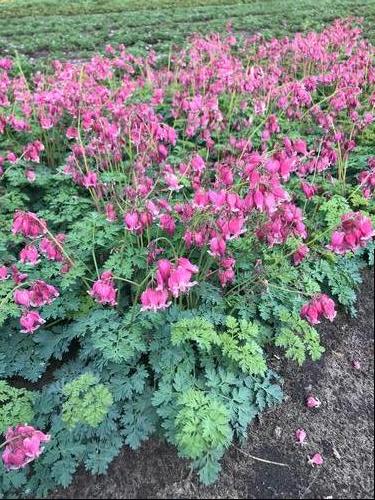
Dicentra 'Luxuriant'


Dicentra (Bleeding Hearts) is an old time favorite for the shade garden characterized by dangling heart-
shaped flowers in spring. Dicentra grows best in filtered sunlight in well-drained soil rich in organic matter. Plants have a tendency to go dormant in the heat of summer or if the soil becomes too dry. To help maintain summer foliage, keep soil evenly moist and provide more shade.
Dicentra ‘Luxuriant’ features deeply-cut, fern-like, grayish-green foliage which persists throught the growing season and cherry red, nodding, heart-shaped flowers carried above the foliage on long, leafless, leaning stems. This variety typically grows to 15” tall. Blooming begins in late spring. With cool weather, this variety will continue to bloom or re-bloom. ‘Luxuriant’ is deer resistant, shade tolerant, and attracts hummingbirds making it a great addition to any garden.